The plague was endemic in 17th-century London, as it was in other European cities at the time.
In late 1664, a bright comet was seen in the sky, and the people of London became fearful, wondering what evil event it portended. London at that time was a city of about 448 acres surrounded by a city wall that had originally been built to keep out raiding bands, and, in the south, by the River Thames. Inside the city was especially dirty and crowded at that time. Outside the city walls, shanty towns with wooden shacks and no sanitation had sprung up, providing homes for the craftsmen and tradespeople who had flocked to the already overcrowded city.
At that time, bubonic plague was a much feared disease, but its cause was not understood. It was not until 1894 that its causal agent, the bacterium Yersinia pestis, was identified by Alexandre Yersin, and its transmission by rat fleas became known.
By July 1665, plague was rampant in the City of London. The rich ran away, including King Charles II of England, his family and his court. The aldermen and most of the other city authorities opted to stay at their posts. The Lord Mayor of London, Sir John Lawrence, also decided to stay in the city. Businesses were closed when merchants and professionals fled. As the plague raged throughout the summer, only a small number of clergymen, physicians and apothecaries remained to cope with an increasingly large number of victims.
The poorer people were also alarmed by the contagion and some left the city. Before exiting through the city gates, they were required to possess a certificate of good health signed by the Lord Mayor and these became increasingly difficult to obtain. As time went by and the numbers of plague victims rose, people living in the villages outside London began to resent this exodus and were no longer prepared to accept townsfolk from London, with or without a certificate. The refugees were turned back, were not allowed to pass through towns and had to travel across country, and were forced to live rough on what they could steal or scavenge from the fields. Many died in wretched circumstances of starvation and dehydration in the hot summer that was to follow.
It is not clear how many people caught the disease and made a recovery because only deaths were recorded and many records were destroyed in the Great Fire of London the following year. In the few districts where intact records remain, plague deaths varied between 30% and over 50% of the total population.
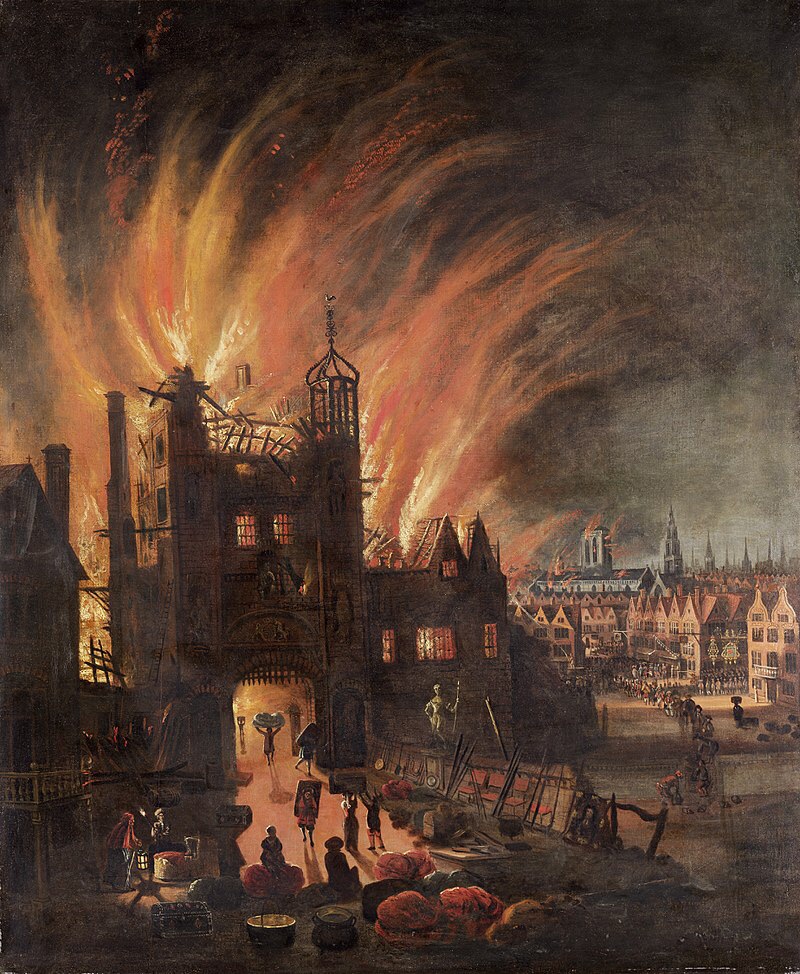
By late autumn, the death toll in London and the suburbs began to slow until, in February 1666, it was considered safe enough for the King and his entourage to come back to the city. That September, the Great Fire of London destroyed much of the City of London, and some people believed that the fire put an end to the epidemic.
The plague in London largely affected the poor, as the rich were able to leave the city by either retiring to their country estates or residing with kin in other parts of the country. The subsequent Great Fire of London ruined many city merchants and property owners.
In addition to the physical changes to London, the Great Fire had a significant demographic, social, political, economic, and cultural impact. The fire seriously disrupted commercial activity, as premises and stock were destroyed and victims faced heavy debts and rebuilding costs.
As a result of these events, London was largely rebuilt and Parliament enacted the Rebuilding of London Act 1666.
The street plan of the capital remained relatively unchanged, but some improvements were made: streets were widened, pavements were created, open sewers abolished, wooden buildings and overhanging gables forbidden, and the design and construction of buildings controlled. The use of brick or stone was mandatory and many gracious buildings were constructed. Not only was the capital rejuvenated, but it became a healthier environment in which to live. Londoners had a greater sense of community after they had overcome the great adversities of 1665 and 1666.
Source: Wikipedia – https://bit.ly/3Hzk0mQ
Painting: Ludgate in flames, with St Paul’s Cathedral in the distance (square tower without the spire) now catching flames. Oil painting by anonymous artist, ca. 1670.
* * * * * *

 Rabbit Hole Truth’s